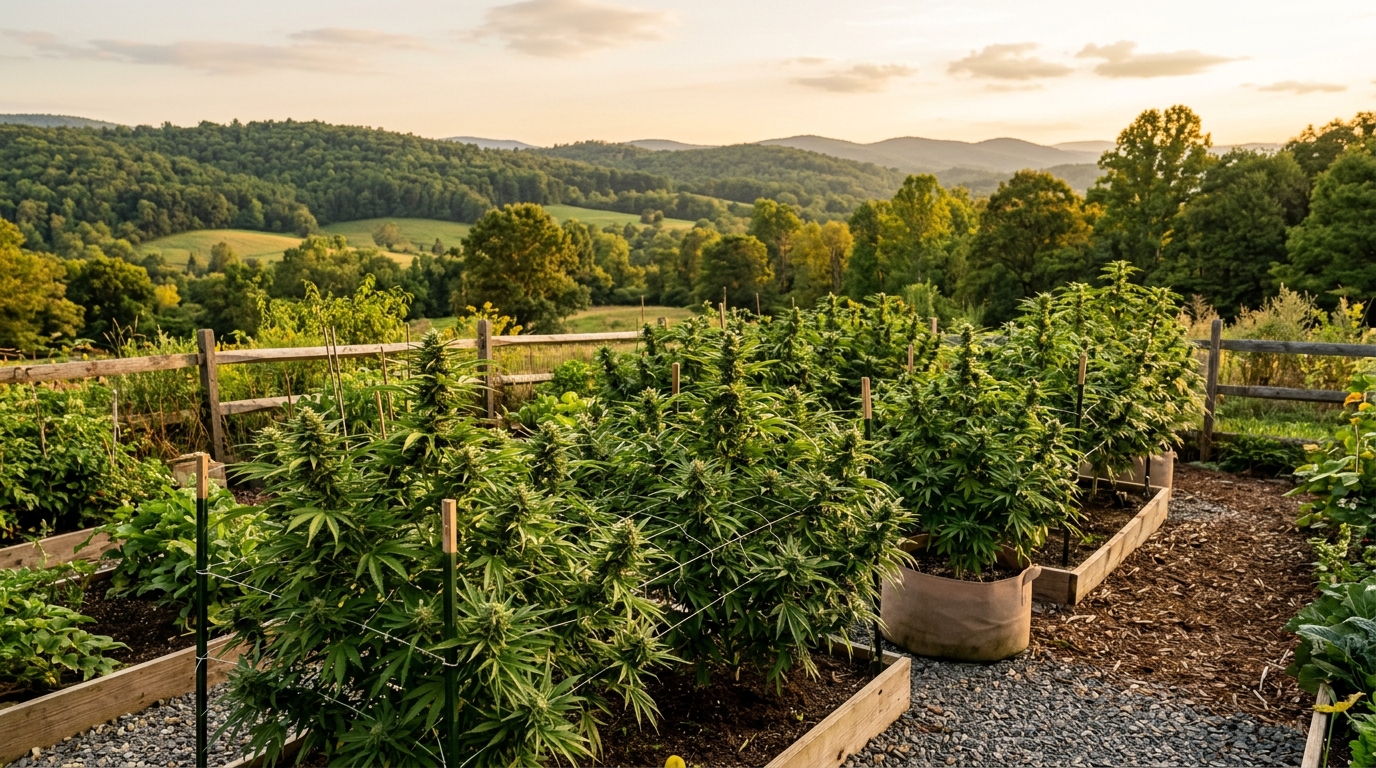
Virginia has one of the longest outdoor cannabis growing seasons on the East Coast. From the sandy soils of Tidewater to the cooler elevations of the Blue Ridge, the Commonwealth offers diverse growing conditions that reward growers who match their genetics to their microclimate. This guide walks through everything a Virginia grower needs to know: frost dates by region, managing the state signature humidity, seasonal timelines, and which strains perform best in each growing zone. Virginia Growing Zones at a Glance Virginia spans USDA hardiness zones 5b through 8a, but for cannabis cultivation, three main regions matter most: Tidewater / Coastal Plain (Virginia Beach, Norfolk, Chesapeake, Hampton, Newport News, Portsmouth) The warmest and most humid region. Last frost typically between March 15 and April 1. First frost often not until November. This is the longest outdoor season in the state — 7+ months. The trade-off: relentless humidity from June through September. Powdery mildew and botrytis are the primary threats. Choose mold-resistant strains. Consider early-finishing genetics that complete flowering before peak humidity in August. Piedmont / Central Virginia (Richmond, Charlottesville, Lynchburg) Moderate climate with distinct seasons. Last frost around April 1-15. First frost late October to early November. 6+ months outdoor season. Less coastal humidity but still humid compared to Western states. Good all-around growing region. Most strains will perform well here with proper air circulation. Blue Ridge / Mountain (Roanoke, Blacksburg, Shenandoah Valley) Cooler nights, shorter season. Last frost can be as late as April 20-May 1 at higher elevations. First frost as early as mid-October. 5-6 month outdoor season. Lower humidity is the advantage — mold pressure is significantly reduced. Choose faster-finishing strains or consider a greenhouse to extend the season. Virginia Outdoor Growing Calendar January–February Plan your season. Order clones and supplies. Start indoor setup if you plan to veg indoors before moving outside. March Start indoor vegetative growth under 18/6 light. By the end of March, clones should be well-rooted and 6-12 inches tall. Tidewater growers can start hardening off plants during warm days. April Transplant outdoors after last frost (April 1-15 Tidewater, April 10-20 Piedmont, April 20-May 1 Mountains). Use row covers or cold frames for the first 2 weeks to protect from late cold snaps. May Peak vegetative growth. Set up trellis/netting. Begin IPM regimen — neem oil, beneficial insects, regular inspection. Virginia pest pressure increases in May. June Continue vegetative growth. Photoperiod plants will be 3-5 feet tall by late June. Last chance to top/train before flowering begins. Humidity management becomes critical in Tidewater. July Flowering begins as daylight decreases below 14 hours. Transition to bloom nutrients. Defoliate lower branches for airflow. Increase calcium and silica for stem strength against summer storms. August Peak flowering. Full humidity management — dehumidifiers if growing in greenhouse, aggressive defoliation outdoors. Scout daily for bud rot in Tidewater region. This is the most challenging month in Virginia. September Late flowering. Most strains will be in weeks 6-8 of flower. Check trichomes with a loupe. Begin flushing 2 weeks before harvest. Humidity typically decreases this month — a relief for growers. October Harvest window. Most strains finish between October 1-15 in Virginia. Earlier in the mountains. Monitor weather — a single frost can end the season. Tidewater growers can sometimes push into late October. November–December Cure your harvest. Dry slowly (60°F, 60% RH, 7-14 days). Cure in glass jars for 2-4 weeks minimum. Plan next year grow. Managing Virginia Humidity Virginia humidity is the number one challenge for outdoor growers. During July and August, relative humidity commonly stays above 70% — prime conditions for powdery mildew and botrytis. Key strategies: Select mold-resistant strains (see recommendations below). Space plants 6+ feet apart for maximum airflow. Defoliate aggressively during weeks 1-3 of flower. Apply potassium bicarbonate or Bacillus subtilis preventatively. Harvest early if bud rot appears — better to harvest at week 7 with amber trichomes than lose the whole plant at week 9. Best Strains for Virginia Tidewater / High Humidity Northern Lights — legendary mold resistance, fast finish (7-8 weeks). GMO — surprisingly resilient, high yield, 9-10 weeks. Blue Dream — tolerates humidity well, massive outdoor yields. Biscotti OG — dense structure with good airflow, 8-9 weeks. Piedmont / General Purpose Gelato 33 — balanced structure, 8-9 weeks. Gorilla Glue #4 — vigorous growth, high potency, 8-9 weeks. Trop Cherry — compact, good for smaller spaces, 8 weeks. Punch Breath — sturdy stems for summer storms, 8-9 weeks. Blue Ridge / Shorter Season Pink Zkittles — fast finisher, 7-8 weeks. Chimera #3 — compact, good for greenhouse, 8-9 weeks. Jet Fuel — resilient to temperature swings, 9 weeks. Green Ribbon — early finisher, low humidity needs. Indoor vs. Outdoor in Virginia Virginia electricity rates are slightly below the national average (~12¢/kWh), making indoor growing economically viable. Many Virginia growers run indoor setups year-round and supplement with outdoor grows during the season. Clone Source genetics perform well in both environments — all strains are phenotyped in indoor controlled conditions before release. Getting Started Today Virginia home cultivation is legal now. You do not need to wait for retail stores to open in July 2027. Order HLVd-tested, rooted clones from Clone Source and start your Virginia grow today. Browse the full strain library at clone-source.com/clones.
Virginia Cannabis Growing Guide — Climate, Seasons & Best Strains for VA Home Growers (2026)
2026-07-09 — Education