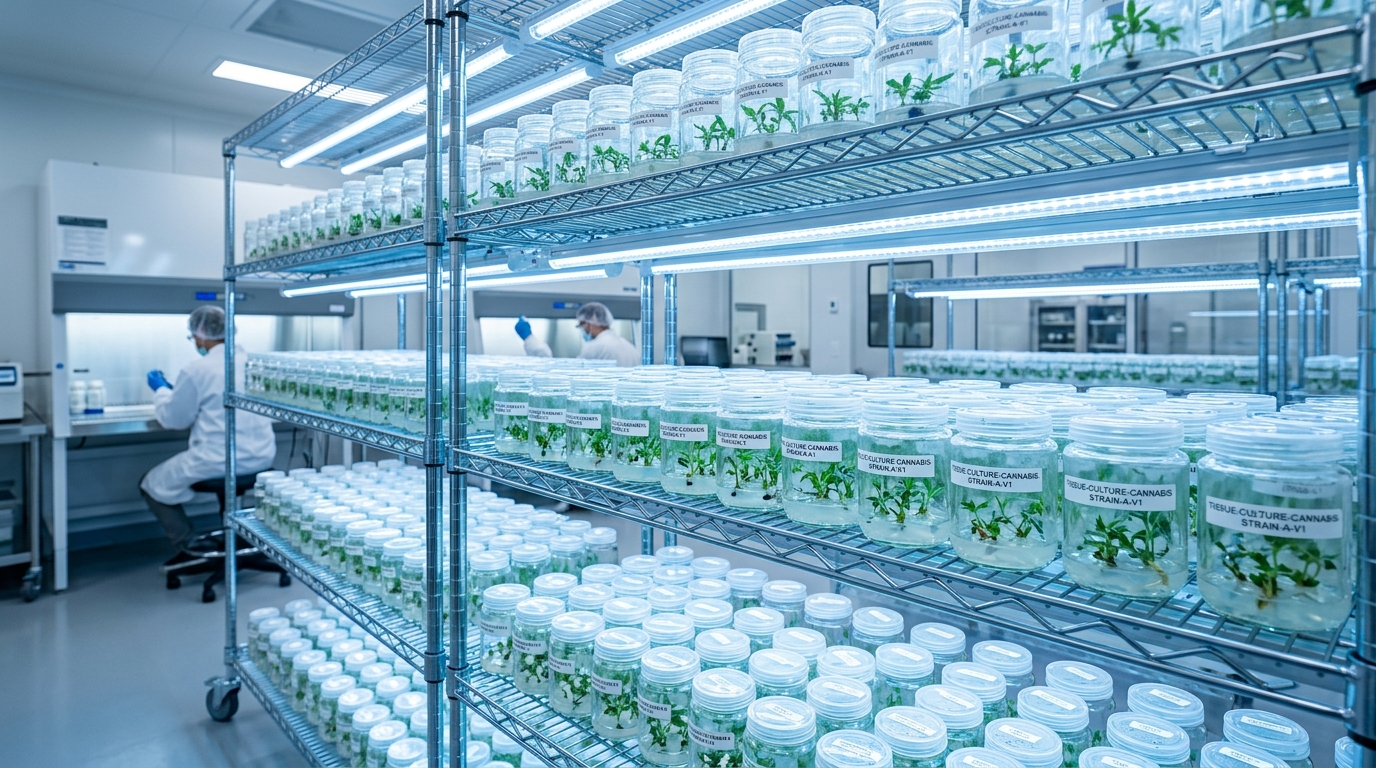
Every commercial cultivator asks the same question when evaluating starting material: what's the actual cost difference between tissue culture clones and traditional clones, and is the premium worth it? The answer isn't just the sticker price — it's the total cost per harvestable pound, factoring in pathogen risk, batch consistency, labor savings, and lost canopy time. After working with facilities ranging from 50 to 500 lights, the data is clear: tissue culture clones deliver lower total cost per pound at commercial scale, even with a higher upfront price per clone. Let's start with the raw numbers. Traditional cannabis clones from a reputable nursery typically cost $10 to $20 per clone, depending on the strain and order volume. Tissue culture clones from a verified lab like Clone Source cost $25 to $100 per clone, with most commercial strains falling in the $50 range. At first glance, traditional clones look 60-80% cheaper. But that's comparing sticker prices — not total cost of production. A 100-light commercial facility running 4 plants per light needs approximately 440 clones to account for 10% selection culling. With traditional clones at $15 each, the genetics bill is $6,600. With tissue culture clones at $50 each, it's $22,000. The $15,400 difference sounds significant — until you factor in what that premium actually buys. Pathogen risk is the single largest hidden cost with traditional clones. Industry diagnostic labs consistently report 10-30% HLVd infection rates in traditional clone stock. That means in a batch of 440 traditional clones, statistically 44 to 132 could carry Hop Latent Viroid — silently. HLVd reduces yield by 30-50% and cannabinoid content by up to 20%, according to multiple controlled studies. If even 20% of your room is infected, that's 88 plants producing 30% less flower. At 2 pounds per plant and $1,000 per pound wholesale, you've lost $52,800 in revenue — more than three times the entire genetics premium you tried to save. Batch inconsistency is the second hidden cost. Traditional clones sourced from multiple mothers — or even a single mother that's accumulated somatic mutations over generations — produce plants with uneven vigor, varying stretch rates, and different finishing times. In a commercial room where every plant needs to finish simultaneously for an efficient harvest, this inconsistency is expensive. If 10-15% of plants finish a week late, that's staggered harvest labor, extra trim runs, and rooms sitting partially empty while you wait. Staggered harvests in a 100-light facility typically add $3,000-5,000 in additional labor and opportunity cost per cycle. Tissue culture clones eliminate both problems. Because every clone comes from the same sterile meristem culture — within one or two subcultures of the original verified mother — they grow with identical vigor, identical stretch, and identical finishing times. Rooms finish uniformly. Harvest crews work efficiently. Canopy space is maximized. And most importantly, multiplex-PCR testing for HLVd, Fusarium, and Pythium means zero pathogen risk at delivery. No yield loss. No staggered harvests. No surprises. Here's the actual cost model for a 100-light facility over one harvest cycle (roughly 10 weeks): Traditional clones: $6,600 genetics + $5,000 staggered harvest labor (from 15% inconsistency) + $26,400 HLVd yield loss (20% of room infected at 30% yield reduction) = $38,000 total cost beyond the genetics price. Total traditional clone extended cost: $44,600. Tissue culture clones: $22,000 genetics + $0 pathogen loss + $0 inconsistency labor = $22,000. That's a $22,600 advantage for tissue culture — before you even account for the long-term genetic drift that degrades traditional mother stock over multiple cycles. Labor savings extend beyond harvest consistency. Tissue culture clones arrive rooted and acclimated, ready to transplant immediately into your production system. Traditional clones often need a 5-10 day hardening-off period where they're gradually introduced to production light levels and nutrient schedules. That's labor hours spent managing a transition that tissue culture clones skip entirely. For a facility transplanting 400+ clones, this saves roughly 15-20 labor hours per cycle — another $300-600 in direct labor savings. The scalability advantage is another factor that doesn't show up on a clone invoice. If you want to scale from 100 lights to 300 lights, you need 1,320 clones per cycle. Traditional nurseries often can't fulfill orders that large on short notice — they're limited by mother plant count and propagation space. Tissue culture labs can scale production exponentially: a single meristem culture can theoretically produce unlimited clones because new tissue is generated in sterile media, not on a finite number of mother plants. Clone Source ships 30,000+ clones monthly from our Colorado lab — a volume that traditional cloning operations simply can't match. Long-term genetic integrity is the final piece of the cost puzzle. Traditional mother plants degrade over 12-18 months — slower rooting, muted terpenes, changed morphology. When your production facility's 'Gelato 33' stops smelling like Gelato 33, your dispensary buyers notice. And when buyers lose confidence in your consistency, they buy from someone else. The cost of replacing degraded mother stock — pheno hunting new seeds, testing candidates, selecting a winner — runs $5,000-15,000 in time and lab testing. Tissue culture eliminates this cycle entirely by maintaining verified genetics in sterile culture, genetically stable across years of production. For home growers running 4-12 plants, the math looks different. A home grower buying 6 traditional clones at $15 each spends $90 on genetics. Tissue culture clones at $50 each would run $300. The $210 difference is real money for a personal grow. If the home grower inspects carefully, quarantines new clones for 10-14 days, and has enough experience to spot early pathogen signs, traditional clones can work well at this scale. But for the home grower who can't afford a failed cycle — where 4 months of electricity, nutrients, and effort produce stunted, low-terpene flower — the tissue culture premium is cheap insurance. Environmental control is another area where tissue culture clones reduce hidden costs. Because tissue culture clones are pathogen-free at delivery, they don't introduce pest populations into your facility — no spider mite eggs hiding in the foliage, no fungus gnat larvae in the root zone, no powdery mildew spores waiting for humidity spikes. Every pest introduction costs money: miticide applications, beneficial insect releases, labor for scouting and spot-treating, and the inevitable yield loss while you get the outbreak under control. A single spider mite outbreak in a 100-light facility typically costs $8,000-15,000 in treatment and lost productivity. Traditional clones are a common vector. Tissue culture clones eliminate this vector entirely. The regulatory landscape adds another dimension to the cost equation. With Section 781's November 2026 deadline approaching, cannabis genetics that produce THC above 0.3% face potential federal reclassification. Labs that can document full breeder provenance, maintain sterile mother stock, and demonstrate transparent testing protocols are better positioned for post-781 compliance than nurseries relying on traditional mother rooms with undocumented cut histories. Tissue culture labs inherently maintain better documentation — every subculture is tracked, every mother is tested, and breeder provenance is verified. If Section 781 disrupts traditional clone supply chains, tissue culture buyers will have uninterrupted access while traditional buyers scramble to find compliant sources. Finally, consider the marketing advantage that consistency creates. Dispensary buyers are creatures of habit — when a batch of Gelato 33 tests at 28% THC with 3.5% terpenes and sells out in four days, they want the next batch to match. If your next harvest tests at 22% THC with muted terpenes because the clones drifted, you've damaged a buyer relationship that took months to build. In Colorado's competitive wholesale market, where 1,000+ cultivators compete for shelf space, batch-to-batch consistency is the difference between a standing order and a one-time purchase. Tissue culture clones deliver that consistency. Traditional clones with undocumented pathogen history and accumulated drift cannot match it. The breakeven analysis is straightforward: if you're running 25 lights or more as a commercial operation, tissue culture clones are cheaper on a total-cost-per-pound basis. Below 25 lights, the pathogen risk math becomes more variable — you might get lucky with clean traditional clones for multiple cycles, or you might not. At Clone Source, we price our clones at $50/strain for most varieties, roughly half what competitors charge for comparable tissue-culture genetics. That pricing model is intentional: we believe tissue culture should be the standard, not the premium option. FAQ: Are tissue culture clones really worth 3x the price of traditional clones? For commercial growers, yes — because the sticker price is only 20-30% of the total cost equation. Pathogen risk, batch inconsistency, and genetic drift drive the real costs. The total cost per harvestable pound is lower with tissue culture clones at any scale above 25 lights. What's the actual yield difference between tissue culture and traditional clones? Identical genetics produce identical yields — the difference is in consistency. Tissue culture clones all finish at the same time, filling canopy space efficiently, while traditional clones with uneven vigor leave gaps and require staggered harvests. On a per-room basis, this consistency typically adds 8-12% to effective yield. How do I verify that tissue culture clones are actually pathogen-free? Ask your lab for multiplex-PCR test results — not just HLVd, but also Fusarium and Pythium. Ask whether every mother is tested or just spot-checks are done. And ask how many subcultures separate the clones you're buying from the original verified mother. Transparent labs will answer all three. Clone Source publishes our testing standards and multiplex-PCR tests every mother plant, every cycle. Bottom line: if you're comparing tissue culture and traditional clones solely on sticker price, you're missing 70-80% of the actual cost equation. At commercial scale, tissue culture clones are the cheaper option — not in theory, but in actual dollars per pound produced. At Clone Source, we've built our entire operation around this principle: clean genetics from day one, priced to be accessible, backed by documented testing that commercial growers can verify. Ready to run the numbers for your facility? Browse our 38-strain catalog or contact us for wholesale pricing and availability.
Micropropagation vs. Traditional Cloning: The Real Cost Comparison for Commercial Growers in 2026
2026-06-16 — Cultivation