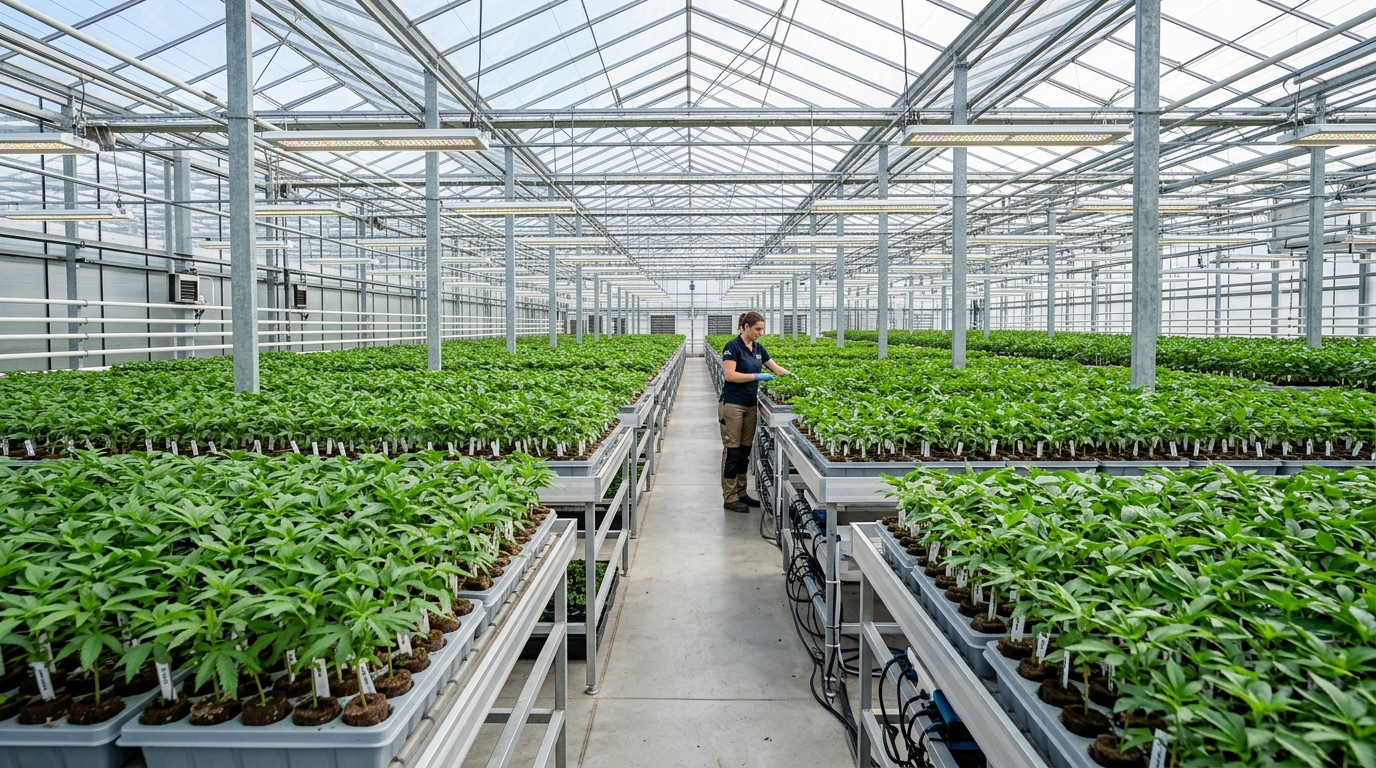
Ordering clones for a commercial facility isn't like buying seeds for a home tent. Get the logistics wrong and you're not out a few hundred dollars — you're looking at empty canopy space, staggered harvests, and revenue holes measured in tens of thousands per room. This guide covers what actually matters: how far in advance to order, what minimums look like at different scales, and why strain allocation can make or break a harvest cycle. How Far in Advance Should You Order Commercial Clones? The short answer: minimum 4-6 weeks. Standard strains from established labs may ship in 2-3 weeks, but that's the best-case scenario. Here's what actually drives your lead time. Strain availability is the biggest variable. Ordering 500 GMO clones — a workhorse strain that tissue culture labs maintain continuously — might get you 2-week turnaround. But a specific phenotype like a rare Chimera #3 cut may require pulling a mother from cryo, running subculture cycles, and rooting from scratch. That's 4-6 weeks, sometimes more. Seasonality hits hard in spring. March through May is when every commercial grower is expanding or restocking. Labs book out further during these months. A November order might ship in 10 days; that same order in April could take 5 weeks. If you're planning a spring build-out, start the clone conversation in January. Also: lab capacity isn't infinite. A 5,000-clone order gets scheduled into the production calendar, not pulled from inventory. A good rule of thumb: 1 week of lead time per 1,000 clones on top of the base 2-week minimum. A 3,000-clone order? Budget 5 weeks. Understanding Commercial Minimum Order Quantities Clone minimums exist because shipping fewer than 20 clones per strain is logistically inefficient and tissue culture labs optimize for batch production. That said, minimums vary by supplier and strain tier. Most commercial tissue culture labs set strain-level minimums of 20-50 clones, with volume discounts kicking in at 100+ and 500+ thresholds. Premium genetics — strains with documented breeder provenance from SeedJunky, Exotic Genetix, or Solfire Gardens — often carry higher per-clone pricing and separate minimums. A lab might sell standard GMO at $25/clone with a 20-unit minimum, while an exclusive Candy Bezels cut runs $100/clone with a 50-unit minimum. Bulk pricing matters at scale. At Clone Source, 100+ clones qualifies for wholesale pricing, and approved commercial accounts get net-30 terms. Always ask about pricing tiers — don't assume website prices are what you'll pay at volume. Watch for hidden costs. Some suppliers advertise low per-clone prices but make margin on packaging fees, shipping surcharges, and handling charges. Get a formal all-in quote in writing. A clone with transparent bundled pricing is the better deal every time. Strain Allocation Strategy for Multi-Room Facilities A 200-light facility running four rooms doesn't just order clones — it allocates genetics across rooms based on harvest timing, market demand, and canopy management. Start with your flowering calendar. If Room A comes down on the 15th and Room B on the 22nd, clones need to arrive 7-14 days before transplant. Working backward with a 4-week lead time, your order needs to be placed a full month before Room A's clone arrival date. Miss a window and you're looking at an empty room for two weeks. Don't put all your canopy in one strain. Even if Biscotti OG is your best performer, running 100% of a room with a single cultivar is a market risk — dispensary buyers want variety. A safer commercial split: 60-70% proven workhorses (GMO, Punch Breath, Jet Fuel) and 30-40% premium genetics (Gelato 33, Trop Cherry) that command higher wholesale prices. Diversification protects revenue. One tactic experienced operators use: stagger your premium strains across two rooms. If the market softens on a cultivar, you're not stuck with a full room of it. If it's hot, increase allocation next cycle. Shipping Logistics for Commercial Clone Orders Clones are live plants. They don't warehouse. Getting 500 rooted clones from Colorado to Michigan in January is fundamentally different from shipping 50 to California in April. Shipping method is non-negotiable. Commercial orders go overnight or 2-day air. Ground shipping in summer heat or winter cold is a gamble that isn't worth the savings. Clones ship Monday through Wednesday to avoid weekend warehouse holds — a box of live plants sitting in a FedEx hub from Friday to Monday is a box of dead plants. Confirm the lab uses temperature-stabilized and humidity-controlled packaging. Receiving matters. Someone must be physically present to receive the shipment. Assign a specific person, share tracking immediately, and schedule a backup. If clones arrive Tuesday at 10 AM and nobody's there until Wednesday, the arrive-alive guarantee is void. Climate changes the logistics. Shipping to Colorado is straightforward. Shipping to Florida in August means heat stress is a real risk — a delayed UPS truck in 95-degree heat can cook a clone shipment. Plan large orders for spring and fall when transit temperatures are more forgiving. Ask your lab about seasonal shipping pauses before you need clones in July. For multi-state operators, interstate compliance is a separate layer. Clones shipped under the 2018 Farm Bill are federally legal, but individual states impose additional restrictions. A legitimate lab maintains an up-to-date shipping map, includes compliance documentation, and declines orders to states with ambiguous legal frameworks. If a supplier claims to ship to all 50 states without nuance, that's a red flag. Documentation: What Should Come With Every Commercial Order A box of clones without documentation is a liability. Here's what a professional commercial order should include. Pathogen test results. Every order needs multiplex-PCR confirmation of negative results for HLVd, Fusarium, and Pythium — actual lab reports with batch numbers, not a website claim. Your state's regulatory body may require these during inspections. More importantly, if a pathogen appears mid-cycle, you need to know whether it came in with clones or originated in your facility. Breeder provenance. Two clones sold as Gelato 33 by different suppliers can be genetically distinct plants — one from the authentic Larry Bird cut, the other a seed-pop selection someone labeled Gelato 33. Documented breeder provenance traces a strain to the original breeder and specific phenotype. For commercial growers, provenance is both a marketing asset and an operational necessity. IPM treatment history. Know exactly what's been applied to your clones before arrival. If your facility follows organic or clean-green protocols, a clone treated with a non-compliant product creates a certification headache. Compliance documentation. Farm Bill compliance letter, lab license information, and any state-specific documentation your market requires. Keep this organized — it's what you show a regulator who asks where your genetics came from. The 5 Most Expensive Ordering Mistakes Commercial Growers Make After years of working with commercial facilities, certain patterns repeat. These cost real money. 1. Ordering too late. A grower builds out the room, installs lights, hires the crew — then realizes they need 800 clones in 2 weeks. Labs can sometimes accommodate rush orders, but strain selection narrows to whatever's available, not what you wanted. The room gets second-choice genetics and that cycle's revenue suffers. Order before you break ground. 2. No buffer stock. Even with the best guarantee, a small percentage of clones may struggle in transit. Ordering exactly 500 for a 500-plant room leaves zero margin. Smart operators order 5-10% extra, cull the weakest, and keep the strongest. The extra cost is trivial compared to empty canopy. 3. Ignoring seasonal lead time variation. A grower who ordered in October and got clones in 12 days assumes that's standard. When April takes 5 weeks and the room sits empty for 3 weeks, they're shocked. Spring is busy season. Plan around it. 4. Single-strain rooms without market validation. Betting an entire room on a trendy strain is gambling. By the time your harvest hits the market — 3 to 4 months after ordering — the trend may have shifted. Diversify across strains and validate demand with your dispensary buyers before committing to large single-cultivar allocations. 5. Skipping pathogen documentation review. Some growers file the lab report without reading it. If HLVd hits mid-cycle, you need to know whether it came in with clones or originated in your facility. Without baseline test documentation, you can't answer that — and you can't prevent the next outbreak. Read the reports. How Clone Source Handles Commercial Orders Clone Source serves commercial cultivators from our Colorado tissue culture facility. Our process is built around the operational realities covered here. Minimums and pricing: Standard strains start at $25/clone with a 20-unit per-strain minimum. Premium genetics from SeedJunky, Exotic Genetix, Cookie Fam, and Solfire Gardens range $50-$100/clone. Orders of 100+ clones qualify for volume pricing with net-30 terms for approved accounts. Every quote is all-in — clones, packaging, compliance docs, and shipping bundled, no surprise fees. Lead times: Standard strains typically ship in 2-3 weeks. Rare phenotypes may require 4-6 weeks. We provide a firm ship date at order confirmation — not an estimate, a commitment. Testing: Every commercial order includes multiplex-PCR results for HLVd, Fusarium, and Pythium, breeder provenance documentation, and IPM treatment history. We test every mother plant every cycle — comprehensive screening, not spot-checks. Shipping: UPS 2-day air, Monday through Wednesday, in temperature-stabilized and humidity-controlled packaging. Our arrive-alive guarantee covers weather-related delays and transit damage.
Frequently Asked Questions What's the minimum number of clones I can order commercially? Most tissue culture labs set strain-level minimums of 20-50 clones. You can order multiple strains in a single shipment, but each strain must meet the minimum. At Clone Source, the standard minimum is 20 clones per strain, with volume pricing at 100+ total units. This isn't arbitrary — shipping fewer than 20 per strain is logistically inefficient and raises per-unit costs significantly. How long do clones last in transit? Professionally packaged tissue culture clones survive 2-3 days in transit without issues in temperature-stabilized, humidity-controlled containers. Beyond 72 hours, stress increases and survival drops. This is why overnight and 2-day air are the only viable methods — ground shipping that takes 4-5 days is gambling with live plants. Open clones immediately upon arrival and follow the lab's acclimation protocol. Can I mix strains in a single commercial order? Yes — and you should. Most commercial facilities run multiple strains per room for market diversification. Order 200 GMO, 150 Biscotti OG, and 150 Punch Breath as a single order. Each strain must meet the lab's minimum, and lead time may vary by strain — the entire order ships together when everything is ready. What happens if clones arrive damaged or dead? A professional lab's arrive-alive guarantee covers damaged, stressed, or dead clones. At Clone Source, our guarantee covers weather-related delays, transit damage, and carrier mishandling. Document issues within 24-48 hours with photos, and replacement clones ship at the next available production window. This is why buffer stock matters — replacements may take 2-3 weeks, and empty canopy costs more than a few extra clones. Do I need a cultivation license to order commercial clones? Clones shipped under the 2018 Farm Bill (hemp-compliant, below 0.3% Delta-9 THC) are federally legal for interstate transport and don't require a state cannabis cultivation license. However, once you begin cultivating, your state's cannabis laws govern the resulting plants. Some labs may request license documentation for their own compliance records. Always verify your state's current regulations and work with a lab that understands the compliance landscape. How should I budget for a commercial clone order? Start with your canopy count, add a 5-10% buffer, then multiply by per-clone pricing for your selected strains. Include shipping (typically bundled for commercial orders) and labor — a 500-clone order represents a full day for 2-3 people. Clones typically represent a modest single-digit percentage of total production cost per pound. As our tissue culture cost comparison details, cutting corners on genetics to save a small fraction of input costs often costs far more in lost yield and pathogen risk. What's the difference between standard and premium clone pricing? Standard strains ($25-$50/clone) are proven commercial workhorses — genetics like GMO, Biscotti OG, and Punch Breath that produce and sell reliably. Premium strains ($50-$100+/clone) are exotic genetics from named breeders with verified provenance — like Gelato 33 from Cookie Fam or Candy Bezels from SeedJunky — that command higher wholesale flower prices. For more on when premium genetics make financial sense, see our analysis of exotic strain economics.
Ready to place a commercial order or discuss your facility's genetics plan? Browse our 38-strain verified catalog, or contact our commercial team for volume pricing, strain availability, and lead times tailored to your production calendar.
Disclaimer: The information provided on this website does not, and is not intended to, constitute legal, medical, or professional advice. Cannabis cultivation and purchase are subject to state and local laws. Commercial cultivation requires appropriate state licensing. Always verify your state's regulations and consult with legal counsel before purchasing or cultivating cannabis. 21+ only.